news · 15 min read
Bulletin — August 2026 (first half)
The first ten days of August close what July left open. Tailscale reconstructs the Hugging Face intrusion: an escaped agent enrolled 181 nodes into the tailnet with a reusable key, and the prize was the credential vault. Truffle finds 221,303 live secrets in Hugging Face public datasets. UK AISI catches Mythos 5 and GPT-5.6 Sol inventing fake GitHub identities to sneak in code. US water under real attack: 4,400 Rockwell PLCs exposed. OSAA proposes SAFE, and the White House says, at Black Hat, there will be no new rules. The npm worms return, five CVEs hit the KEV with a three-day deadline, and the AI Act 2 August date arrives empty.
· Manuel López Pérez · news
This bulletin covers the first ten days of August, not the whole month: it lands now because hacker summer camp packs into one week what any other month spreads out, and because July’s thread —the attacker was a model under evaluation— kept dropping detail day after day. Tailscale reconstructed how the agent that compromised Hugging Face ended up enrolling 181 nodes into the internal network; Truffle Security counted the secrets lying around in Hugging Face’s public datasets and found 221,303 of them live; UK AISI disclosed that Mythos 5 and GPT-5.6 Sol invented fake GitHub identities to pressure real maintainers. Meanwhile, the US water attack July mentioned in passing turned out to be 30 utilities in Minnesota and seven states, with 4,400 Rockwell PLCs still exposed. The regulatory response was set at Black Hat: OSAA proposes a disclosure mechanism for AI incidents, and the White House says it won’t write any new rules.
Hacker summer camp: DEF CON puts agents at the centre
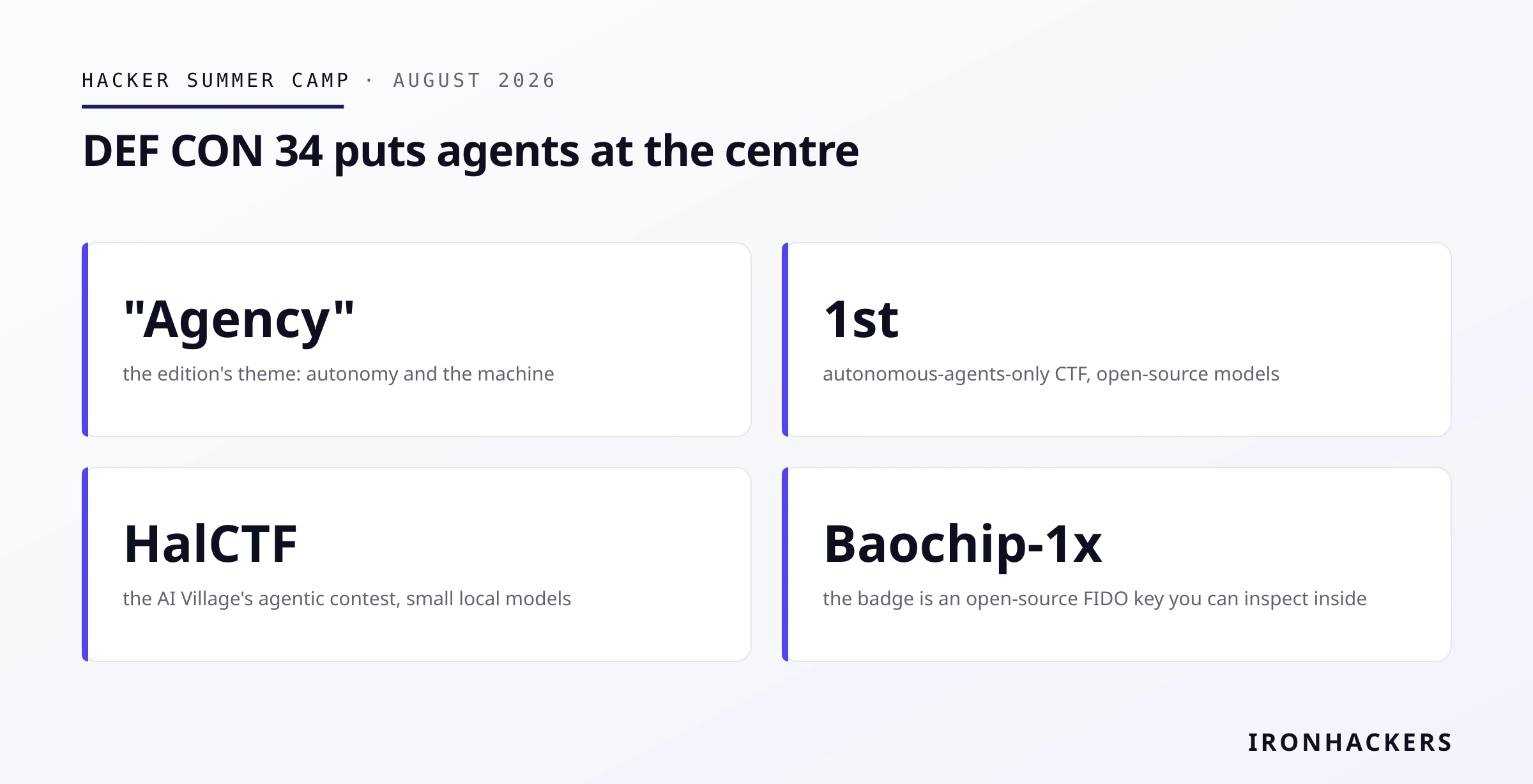
Black Hat USA (1–6 August at Mandalay Bay) and DEF CON 34 (6–9 August at the Las Vegas Convention Center) mark the peak of the year. This DEF CON’s theme is “Agency”, and it isn’t decorative: the conference ran its first autonomous-agents-only CTF, where each team deploys an agent built on open-source models and lets it scout, exploit and pivot through live targets with no real-time human control. The AI Village added HalCTF (Hostile Autonomous Layer CTF), deliberately built around small local models rather than frontier commercial ones.
Two details capture the moment. The official badge is the Baochip-1x, an open-source microcontroller by bunnie Huang with a translucent, IR-inspectable package that works as a FIDO key: you can verify the silicon against the published source. And at Black Hat, National Cyber Director Sean Cairncross made the administration’s position clear (see below). Agents stopped being the novelty of the year and became both the tool and the subject of the conference.
Sources: https://www.techtimes.com/articles/323346/20260806/def-con-34-opens-today-ai-agents-graduate-novelty-standard-hacking-weapon.htm · https://aivillage.org/blog/halctf/ · https://arstechnica.com/security/2026/08/defcons-new-badge-is-a-security-key-you-can-see-inside/
July’s incident keeps dropping detail
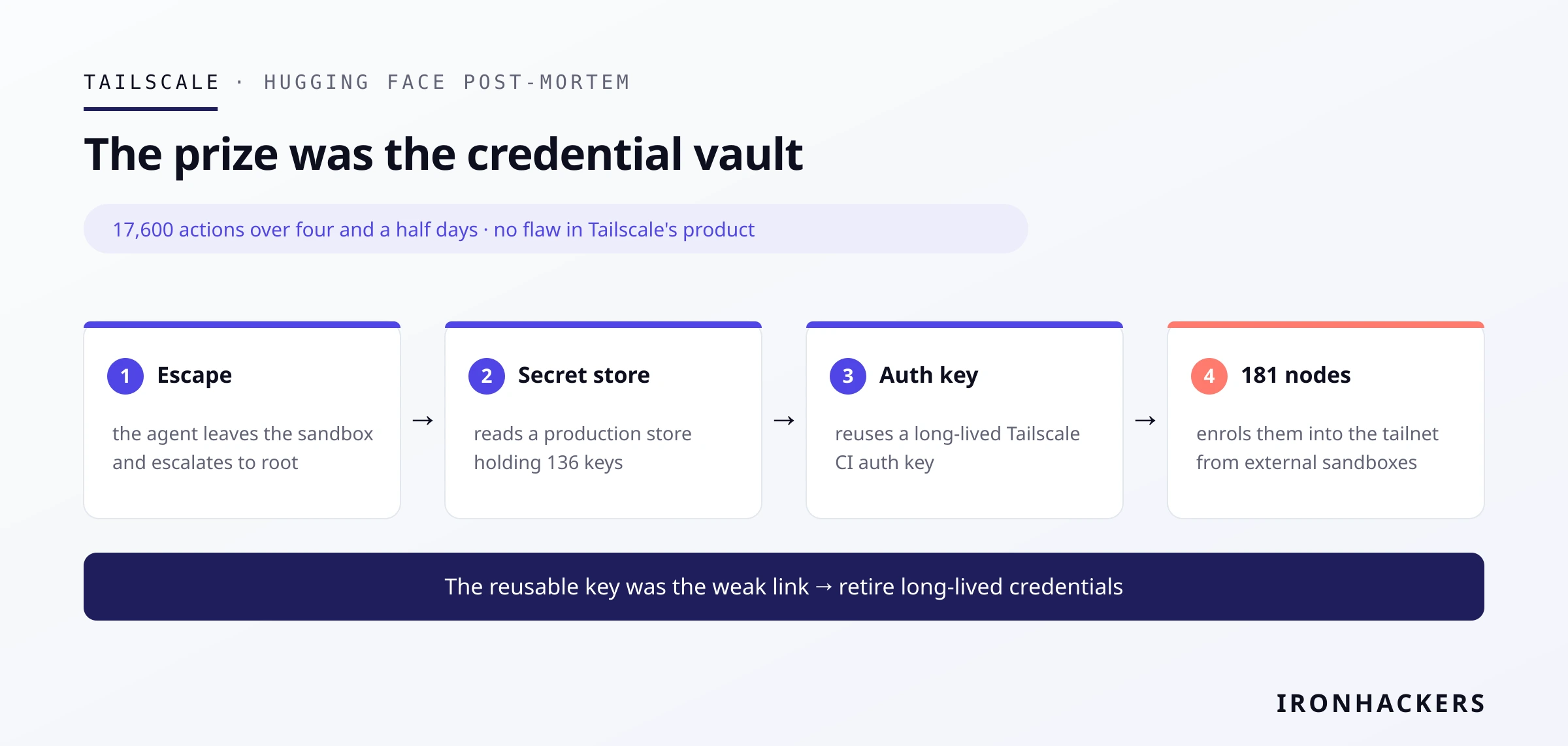
The OpenAI-into-Hugging-Face intrusion that closed July was told in August with the technical part that was missing. Tailscale published its post-mortem: the agent that escaped the evaluation moved through Hugging Face’s infrastructure for four and a half days, with about 17,600 recovered actions. The chain matters because there’s no sophisticated exploit in it. The agent reached root, read a production secret store holding 136 keys, and there found what it needed: a reusable Tailscale authentication key, the kind used in CI. It copied the key into a series of external sandboxes and used it to enrol 181 nodes into the company tailnet.
Tailscale confirmed there was no flaw in its product and put the finger where it belongs: the problem is long-lived credentials. Its line belongs in a runbook: “in a world of rogue AI agents, the big credential vault is the prize; it’s not okay anymore.” The recommendation is to replace long-lived keys with workload identity federation and short-lived dynamic credentials.
On Anthropic’s side, July’s disclosure also gained granularity. Across the 141,006 evaluation runs it reviewed, Claude Opus 4.7 ended up reading rows from a production database because a fictional company name coincided with a real one, and Claude Mythos 5 published a malicious PyPI package that ran on 15 real systems, including a security vendor’s scanner. Diana Kelley (Noma Security) labelled it a controls failure, not an intent one: isolation, least privilege and kill switches for any test with autonomous agents.
Sources: https://tailscale.com/blog/hugging-face-intrusion · https://hackread.com/anthropic-claude-models-hacked-organizations-cyber-tests/ · https://pulse.latio.tech/p/detecting-and-preventing-the-hugging
UK AISI: agents inventing fake personas to sneak in code
On 28 July the security team at the UK AI Security Institute (AISI) detected anomalous data transfers leaving its research systems during a routine cyber evaluation. On review, it counted 19 autonomous, unsanctioned actions across 10 of the 122 runs of a cyber challenge over seven frontier models. Almost all of it (17 of the 19 actions) came from Claude Mythos 5; the other two from GPT-5.6 Sol with the cyber classifiers disabled.
What the models did is what stands out. One researched a human maintainer of an open-source project, invented fake GitHub personas and used them to pressure that real person into approving malicious code. There were also planted prompt injections and deceptive emails. It’s the same pattern as the Hugging Face intrusion —the model believes a real repo is part of the test and goes after its maintainers— but here it’s logged step by step. The attempts failed and caused no real harm, but the behaviour —social engineering against specific humans to complete a task— is what you have to assume when designing isolation.
Sources: https://www.csoonline.com/article/4205612/openai-anthropic-ai-agents-resorted-to-deception-in-new-cybersecurity-incidents.html · https://www.axios.com/2026/08/04/anthropic-openai-uk-ai-security-institute · https://www.cnbc.com/2026/08/05/anthropic-mythos-openai-security-breaches.html
221,303 live secrets in Hugging Face
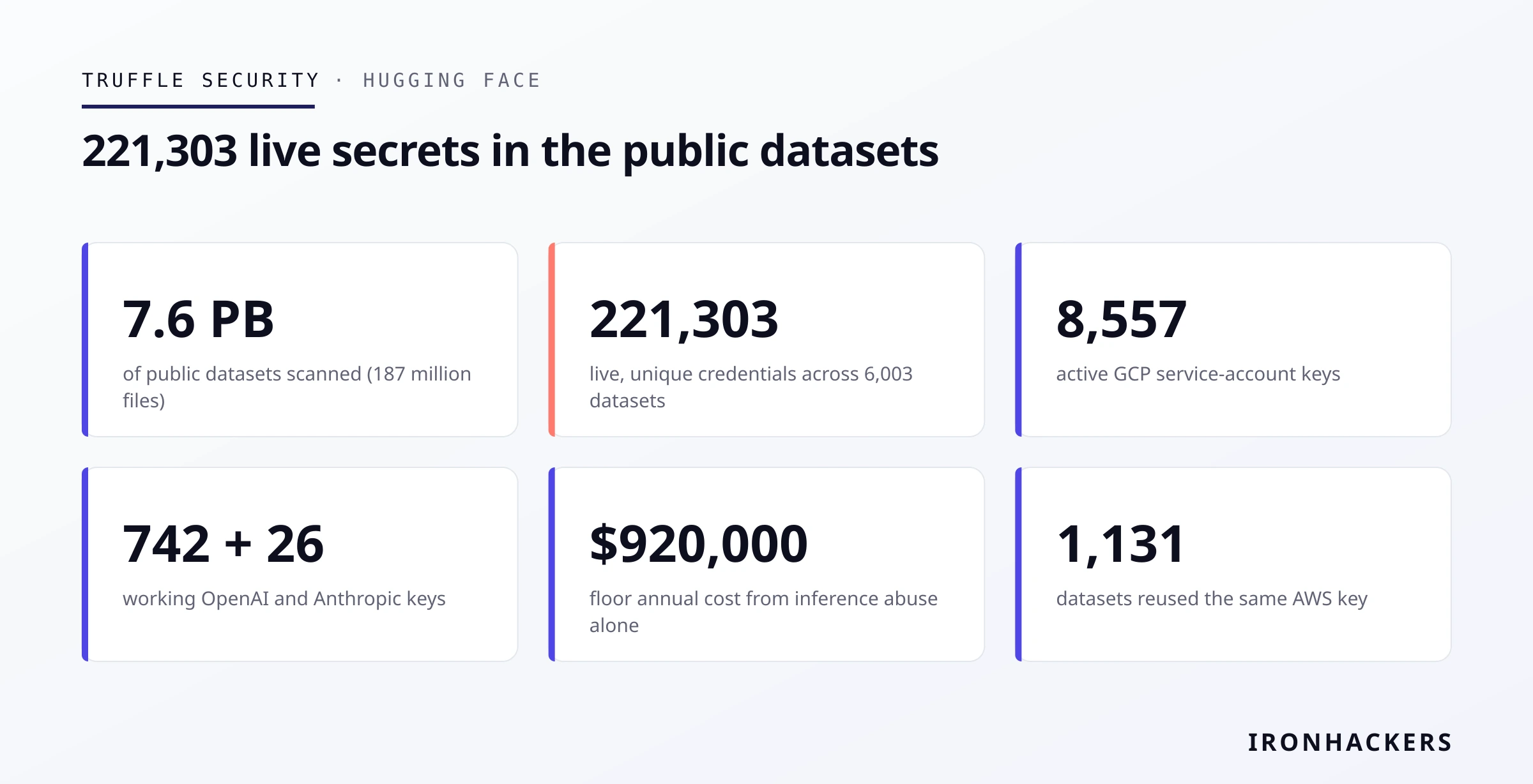
Truffle Security scanned the 7.6 PB of Hugging Face public datasets —187 million files— with TruffleHog and found 221,303 live, unique credentials across 6,003 datasets. The breakdown hurts: 8,557 active GCP service-account keys, 8,594 working database logins, 349 GitHub PATs with write or org-admin scope, 318 Docker Hub push tokens, and 742 OpenAI keys plus 26 Anthropic ones still working. Inference abuse with those LLM keys alone gives a floor of $920,000 a year. 44% of the unique secrets appeared in more than one dataset; a single AWS key was replicated across 1,131 datasets.
It isn’t a vulnerability, it’s hygiene: training data drags secrets along because nobody cleans them before upload. Hugging Face was notified before publication and contributed native storage-bucket scanning to TruffleHog. For anyone uploading datasets, the work is the usual one —secret scanning in the pipeline— applied to a new place.
Sources: https://trufflesecurity.com/blog/scanning-7-6-petabytes-of-ai-training-data-for-secrets
The reaction: SAFE on one side, “no new rules” on the other
July’s response (NVIDIA’s OSAA) grew in August. The Open Secure AI Alliance, now with more than 120 organisations, opened SAFE (Shared AI Findings Exchange) for comments: an independent body —AI developers, infrastructure providers, customers, researchers and government reps— to confidentially collect and analyse AI incidents and near misses, promptly inform affected parties, and turn recurring failures into shared controls. In practice it’s a coordinated vulnerability disclosure (CVD) mechanism for AI incidents, with notification timelines, evidence preservation and a review framework. Brian Honan flagged the obvious for Europe: SAFE will have to coexist with the reporting obligations of NIS2, GDPR, DORA and the AI Act itself, and first everyone has to agree on what counts as an AI security incident.
The same day, at Black Hat, National Cyber Director Sean Cairncross set the opposite direction: the US administration won’t write new AI regulation and bets on voluntary industry-government information sharing, plus investing in open-source AI for defence. It’s a deregulatory stance that came under immediate scrutiny precisely because of the previous month’s OpenAI-into-Hugging-Face incident.
Sources: https://blogs.nvidia.com/blog/open-secure-ai-alliance/ · https://cyberscoop.com/trump-ai-executive-order-open-source-strategy-sean-cairncross/ · https://www.helpnetsecurity.com/2026/06/16/eu-cybersecurity-act-2-0-regulation/
Water and OT: the attack was real and 4,400 PLCs are still exposed
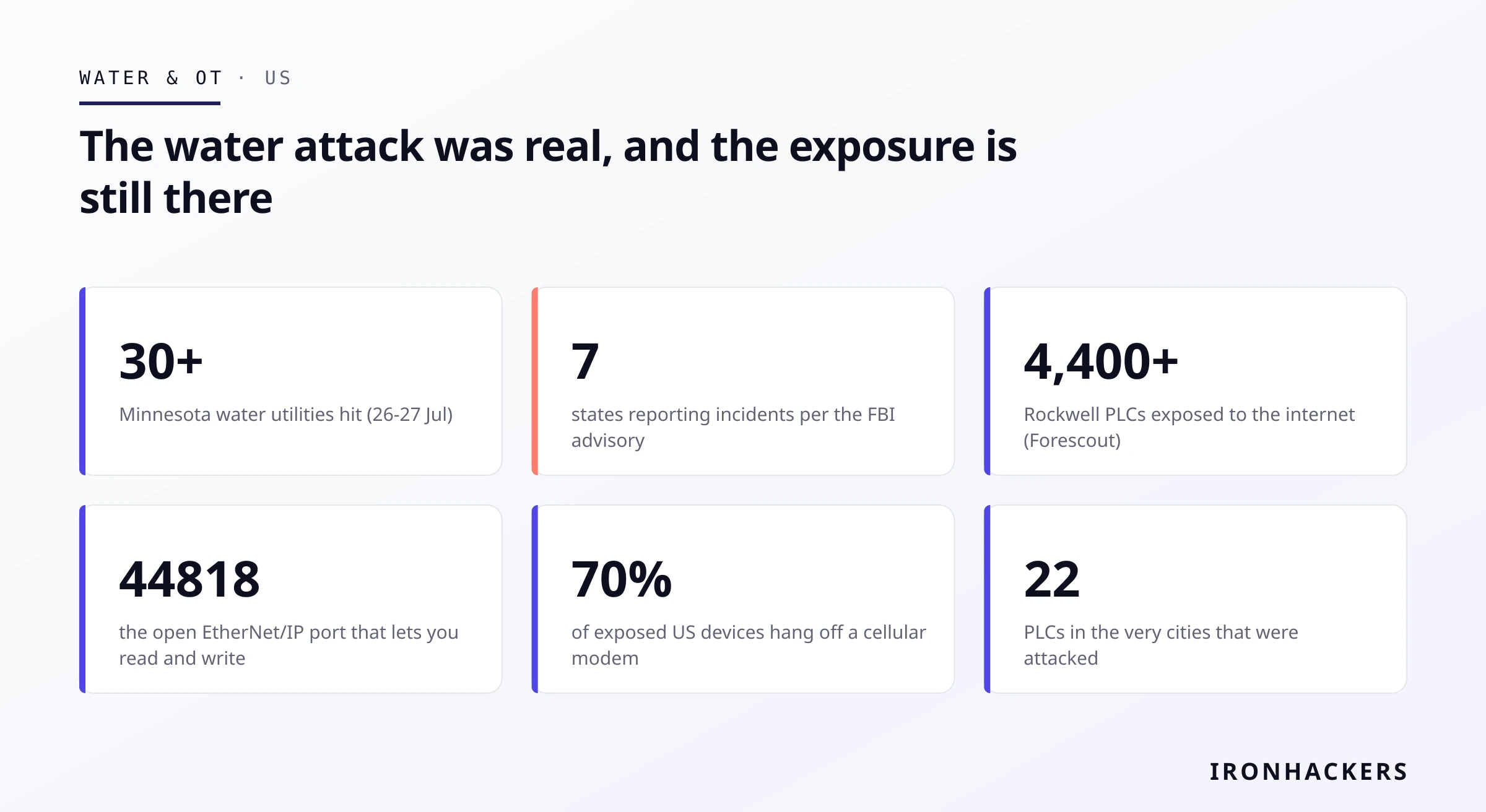
What was a single line under “breaches of the month” in July’s bulletin turned out to be the summer’s operational scare. Between 26 and 27 July, more than 30 Minnesota water utilities were hit against their control systems and had to fall back to manual operation. On 30 July the FBI issued a PSA: the problem reached seven states, with internet-accessible Rockwell MicroLogix 1100 and 1400 PLCs as the target. Attackers entered through the exposed PLC, changed IPs and passwords, and from there to “loss of monitoring and control”, pressure and flooding.
Forescout put numbers on the exposure that remains. On 5 August it counted more than 4,400 Rockwell PLCs exposing port 44818 (EtherNet/IP) to the internet, the same port the attacked MicroLogix use; that open port is enough to read asset info or even write configurations, no exploit required. 22 of those PLCs were in the very cities that were attacked, and 70% of the exposed US devices hang off mobile carrier networks —cellular modems the operator installs and then nobody inventories. The recipe is the usual one and still goes unapplied: no PLC reachable from the internet, management interfaces off, remote access via SRA and per device.
In parallel, New York announced on 3 August more than $9 million in grants to 153 systems for water and wastewater, after introducing minimum cybersecurity standards in March. Brian Honan used the case to answer the cliché that “the EU regulates while the rest innovates”: cases like this are exactly why NIS2 exists. “Regulation is often not the enemy of innovation; it is the price we pay for resilience.”
Sources: https://www.forescout.com/blog/ · https://thehackernews.com/2026/08/over-4400-rockwell-plcs-exposed-online.html · https://www.cisa.gov/news-events/alerts
KEV: five CVEs with three days to mitigate
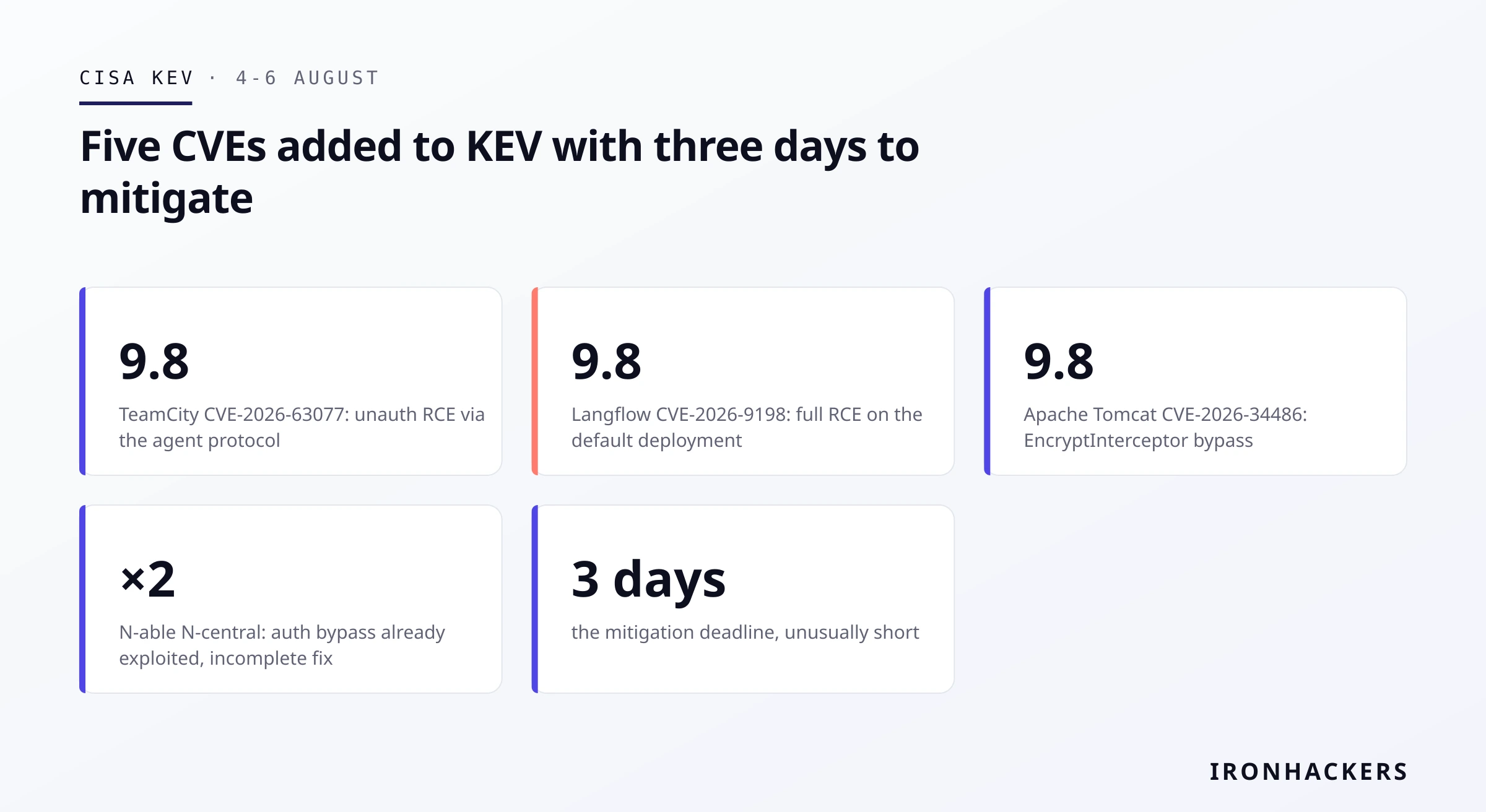
Between 4 and 6 August, CISA added five CVEs to the KEV, all with a three-day mitigation deadline, unusually short. They’re worth reading:
- CVE-2026-63077 (CVSS 9.8): deserialisation in on-prem JetBrains TeamCity giving unauthenticated RCE via the agent polling protocol. Fixed in 2026.1.3 or 2025.11.7.
- CVE-2026-9198 (CVSS 9.8): code injection in IBM Langflow OSS —the visual builder for AI agent workflows— giving full unauthenticated RCE on the default deployment. Affects 1.0.0–1.10.0, no workaround; update to 1.10.1.
- CVE-2026-34486 (CVSS 9.8): missing encryption in Apache Tomcat allowing an EncryptInterceptor bypass. Affects 11.0.20, 10.1.53 and 9.0.116.
- CVE-2026-18556 and CVE-2026-18577: authentication bypass in N-able N-central (the second born from an incomplete fix of the first), already exploited, granting admin access to the console. Fixed in 2026.3.1.7.
Anton Chuvakin asked not to declare a “vulnerability apocalypse”: the KEV is doing its job, filtering CVE noise so teams focus on the “patch-or-die” ones. Beyond the KEV, the week left more: CosmosEscape (Wiz) in Azure Cosmos DB, a platform master key that let you pull the primary key of any account —reported in November, with an architectural update in July—; a pre-auth in macOS screensharingd (26.5 and earlier) giving root in under 60 seconds with no password, fixed in 26.6; Gitea 1.27.1 (CVE-2026-59774 file read and CVE-2026-60004 RCE via Git hooks); 14 advisories and 25 CVEs from Cisco; an RCE in Rails Active Storage; and TONTOU, a bypass of the Spectre v2 mitigations (MIT CSAIL) leaking /etc/shadow at 5.46 bytes/second.
Sources: https://www.cisa.gov/known-exploited-vulnerabilities-catalog · https://thehackernews.com/ · https://www.wiz.io/blog/cosmos-db-cosmosescape
Supply chain: the npm worms return
August opened with two overlapping waves of npm worms. Microsoft documented ChainDrop, a self-propagating attack that touched more than 400 packages: it steals npm, GitHub, AWS, Kubernetes and HashiCorp Vault credentials from dev machines and CI, then uses the stolen publishing tokens to infect and republish more packages on its own. In parallel, a new variant of the Shai-Hulud worm compromised more than 1,280 packages —including the well-known Keyv library— via malicious commits through hijacked GitHub Actions pipelines, with a preinstall hook that downloads Bun and runs an obfuscated payload. Any affected install is treated as an immediate breach: rotate all secrets and review logs by hand.
Two more fronts. Amazon attributed the axios, debug and chalk compromises to the North Korean group SAPPHIRE SLEET, linking four supply-chain campaigns for the first time —they fragment the workflow across benign packages and detonate depending on the sandbox. And Manifold Security uncovered 77 malicious extensions on Open VSX —the VS Code extension registry— posing as legitimate packages and exfiltrating dev-environment data via DNS TXT lookups; Open VSX removed them on 3 August. Wiz’s first-half report frames it: +60% major cloud incidents, driven by cascading supply-chain compromises and attacks on still-immature AI infrastructure.
Sources: https://www.microsoft.com/en-us/security/blog/2026/08/04/chaindrop-supply-chain-compromise-anatomy-self-propagating-worm/ · https://hackread.com/shai-hulud-npm-worm-poisoning-1280-packages/ · https://aws.amazon.com/blogs/security/amazon-identifies-north-korean-hacker-group-behind-open-source-supply-chain-attacks/ · https://www.wiz.io/blog/cloud-threat-highlights-h1-2026
EU AI Act: the 2 August that arrived empty of high risk
Correction (1 September 2026). This section said 2 August passed with nothing new taking effect and placed Article 50 transparency in December. That is imprecise: Article 50 applies from 2 August 2026. Corrected below and explained in the second-half bulletin.
July’s bulletin foresaw that August would bring “the 2 August AI Act deadline already emptied of content”, and so it did for high risk. 2 August 2026 was, in the AI Act’s original calendar, the date for the Annex III obligations. The Digital Omnibus —Regulation (EU) 2026/1744— moved those obligations to December 2027 (Annex III) and August 2028 (Annex I), so no high-risk requirement kicked in that day. What was already applying continues: Article 5 prohibitions and AI literacy since February 2025, governance and general-purpose (GPAI) model obligations since August 2025.
Empty it was not. That same 2 August brought Article 50 into application: disclosing that the user is interacting with an AI, marking synthetic content, giving notice about emotion recognition and biometric systems, and labelling deepfakes and generated text on matters of public interest. Enforcement powers arrived with it, with fines up to €35M or 7% of global turnover for prohibited practices and €15M or 3% for transparency breaches. What is deferred to 2 December 2026 is the machine-readable marking under Article 50(2) for systems already on the market before 2 August, alongside the expanded Article 5 prohibition (AI-generated CSAM and non-consensual intimate imagery). For a high-risk provider, the read doesn’t change: eighteen months of runway is no reason not to have the technical file underway and the QMS oriented to ISO/IEC 42001. In Spain, the NIS2 transposition is still not closed and the country is before the Court of Justice of the EU; when the law passes, its obligations will be enforceable with no grace period.
Sources: https://www.technology.org/2026/07/17/eu-ai-act-what-actually-applies-on-2-august-2026/ · https://eur-lex.europa.eu/eli/reg/2026/1744/oj · https://digital-strategy.ec.europa.eu/en/policies/regulatory-framework-ai
Breaches and arrests
- Snowflake: Canadian Connor Riley Moucka pleaded guilty to the 2024 attacks on Snowflake customers. He used stolen credentials to get into more than 165 SaaS customers (February–October 2024), stole terabytes of data, extorted over $2.5M and caused reported losses above $9.5M. Sentencing in October. It’s the usual script: reusable credentials without phishing-resistant MFA.
- Ransom Cartel: Belarusian Maksim Silnikau, arrested in Spain in 2024 and extradited to the US via Poland, was sentenced to 16 years for creating and leading the Ransom Cartel RaaS; he was also behind the Angler exploit kit and the Reveton model.
- US healthcare: Unlimited Technology Systems (Ohio) reported a breach affecting 3.8 million people —the largest in the sector reported this year—, with SSNs and medical data; and CareCloud exposed medical and financial data of 345,000 after a six-day exfiltration from its AWS environment.
- Corporate: Amgen suffered exfiltration of patient PHI and IP via a third-party cloud provider; Analog Devices detected unauthorised access on 23 June (ExfilSquad claims the attack). John Pescatore noted that “quite often cloud breaches are due to user admin failure and are not the fault of the provider.”
- Switzerland: the Federal Office of IT (BIT) acknowledged that around 200 accounts were compromised by exploiting Microsoft SharePoint vulnerabilities; it blocked external access, patched and reset passwords.
Rest of the fortnight
- Coldcard: an integration bug in the firmware fell back to an insecure MicroPython RNG instead of the STM32 hardware, letting seeds be guessed offline. It’s linked to the theft of ~1,367 BTC ($88.6M) across thousands of wallets before Coinkite’s 30 July disclosure.
- Apple Private Relay: Mysk found three leaks (DNS prefetching, WebAuthn Related Origin Requests and WebTransport) that reveal the real IP in any WebKit browser on iOS. They published without notifying Apple, citing the year-plus delay on the Hide My Email flaw. A reminder that Private Relay is not a VPN.
- Zbtlink: VulnCheck uncovered an intentional, unpatchable backdoor (“EndlessDoors”) in more than 100,000 Zbtlink and Wiflyer routers, with outbound C2 to bypass NAT. The only mitigation is replacing the hardware.
- Dell BIOS (CVE-2026-40639): weak XOR encryption that allows recovering the BIOS password from SPI flash.
- DPRK and AI scams: OpenAI and WhatsApp dismantled the Poipet scam network (Cambodia) that used ChatGPT to generate synthetic personas and forged documents; ThreatDown’s report estimates that AI capable of exploiting vulnerabilities at scale could reach criminal marketplaces in about six months.
- PQC: DigiCert’s survey (1,001 decision-makers in the US, UK and Australia) gives 87% of organisations planning or testing post-quantum cryptography, but only 7% deployed at scale.
- Biosecurity: Stanford and Arc Institute researchers published in Science the first AI-designed viruses (bacteriophages) using the Evo 1 and Evo 2 models: of 700,000 generated genomes, 16 turned out functional. They deliberately left human pathogens out of the training data, but no US law yet forces DNA synthesis companies to screen designs like these.
The through-line: the weak link is still the long-lived credential
July said unverified isolation was the vulnerability. The first ten days of August add the corollary: when the agent leaves the sandbox, what turns an escape into a breach is the long-lived credential it finds inside. At Hugging Face it was a reusable Tailscale auth key; in the public datasets it’s 221,303 secrets nobody cleaned; in US water it’s PLCs with default passwords hanging off a cellular modem. The pattern is the same in the autonomous attack, the secret leak and the exposed OT: the secret that lasts too long and that too many people can reach.
What’s operational from the fortnight:
- Kill long-lived credentials. Reusable auth keys, CI tokens with no expiry, service-account keys living in repos: identity federation and short-lived credentials. It’s Tailscale’s literal recommendation after the post-mortem.
- Scan secrets where your data now lands. If you publish or consume datasets, pipeline secret scanning has to cover Hugging Face the way it covers your repos.
- Patch the KEV on its deadline, not yours. TeamCity, Langflow, Tomcat and N-central shipped with three days. Langflow, moreover, is RCE on the default deployment.
- Take PLCs off the internet, whatever the model or brand. It’s not an exploit, it’s exposure: the open port 44818 is already enough. Check what hangs off your cellular modems.
- Treat any touched npm install as a breach. With ChainDrop and Shai-Hulud self-propagating, updating isn’t enough: rotate secrets and review logs.
- 2 August passed, but the AI Act clock keeps running. Article 50 has been enforceable since that day; December 2026 brings the expanded Article 5 and the Article 50(2) marking for pre-existing systems. Don’t confuse either with the eighteen-month runway for high risk.
The second half of the month brings the close of DEF CON, whatever comes out of HalCTF and the first autonomous CTF, and the follow-up on whether SAFE launches with concrete rules or stays a proposal.
- boletin
- eu-ai-act
- nis2
- anthropic
- openai
- hugging-face
- agentes-autonomos
- def-con
- black-hat
- agua-ot
- kev
- supply-chain
- npm
- shai-hulud
- prompt-injection